
Protecting Birds: One Goal, Many Needs
Protecting birds isn’t a one-size-fits-all effort—every species has unique needs. Grassland birds depend on open fields and native prairie. Forest species rely on mature tree cover. Migratory songbirds need safe stopover habitat and dark skies for navigation. Raptors require large hunting territories and minimal disturbance.
Because each bird faces different challenges—habitat loss, window collisions, light pollution, pesticides, or climate change—our conservation strategies must be just as diverse. Some solutions happen at home, like gardening with native plants or keeping cats indoors. Others happen at the community level, such as protecting open spaces, restoring wetlands, reducing artificial lighting, or designing bird-friendly buildings.
By understanding what every bird needs to survive and thrive, we can take targeted actions that truly make a difference. Every habitat, every species, and every thoughtful choice adds up to a safer world for birds!
7 Simple Actions
You Can Take to Help Birds
In 2019, scientists documented North America’s staggering loss of nearly three billion breeding birds since 1970. Helping birds can be as simple as making changes to everyday habits. Here’s a checklist of 7 Simple Actions you can take to help birds!
Bring the importance of bird conservation to your next conversation with five specific reasons why birds matter and an in-depth article on the economic value of birds.
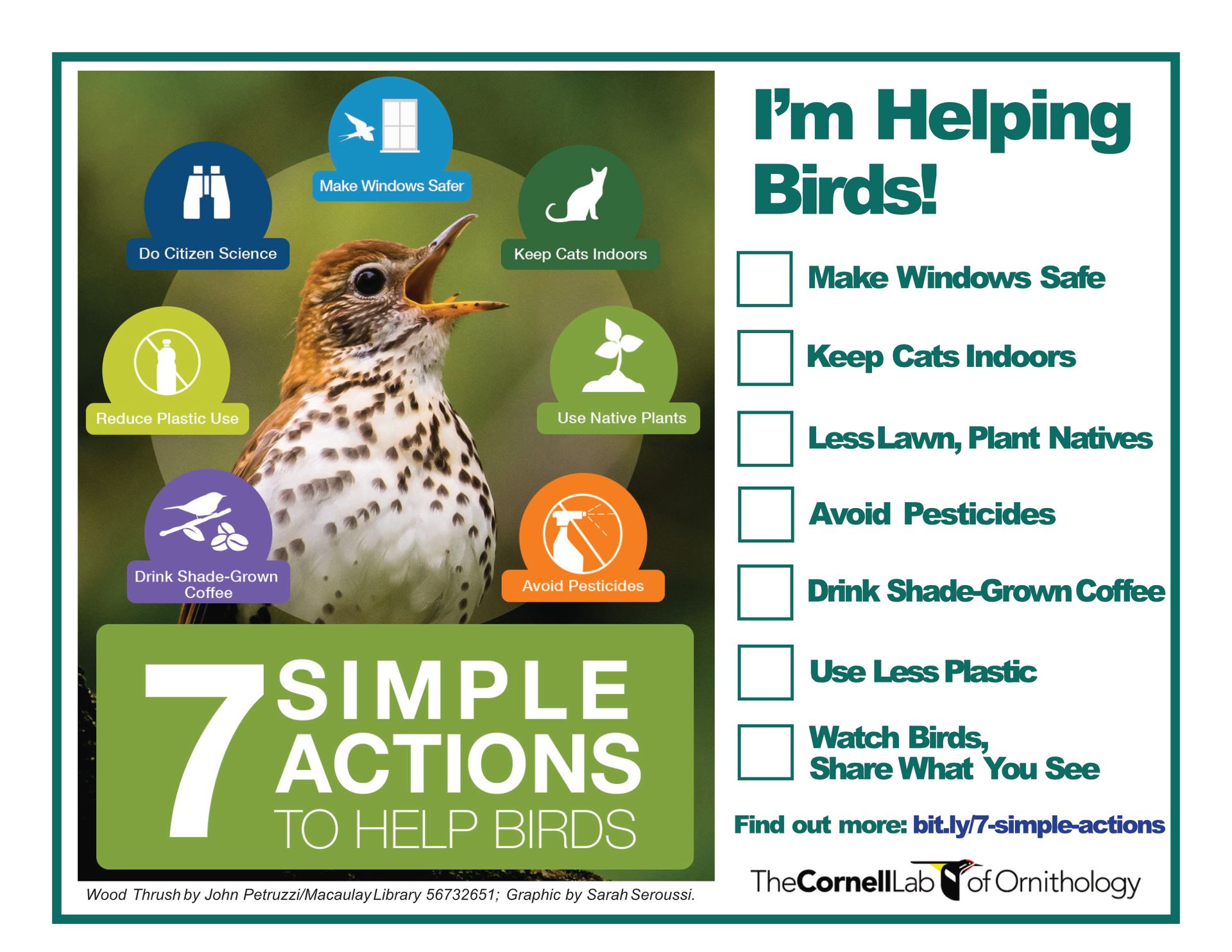
Click image to download and print

Make Windows Safe
The challenge: Up to 1 billion birds are estimated to die each year after hitting windows in the United States and Canada.
The cause: By day, birds perceive reflections in glass as habitat they can fly into. By night, migratory birds drawn in by city lights are at high risk of colliding with buildings.

Keep Cats Indoors
The challenge: Cats are estimated to kill more than 2.4 billion birds annually in the U.S. and Canada.
The cause: These nonnative predators instinctively hunt and kill birds even when well fed.

Use Native Plants
The challenge: Birds have fewer places to safely rest during migration and to raise their young: More than 10 million acres of land in the United States were converted to developed land from 1982 to 1997.
The cause: Lawns and pavement don’t offer enough food or shelter for many birds and other wildlife.
Avoid Pesticides
The challenge: More than 1 billion pounds of pesticides are applied in the United States each year.
The cause: Pesticides that are toxic to birds can harm them directly through contact, or if they eat contaminated seeds or prey.

Drink Shade-Grown Coffee
The challenge: Three-quarters of the world’s coffee farms grow their plants in the sun, destroying forests that birds and other wildlife need for food and shelter.
The cause: Too few consumers are aware of the problems of sun coffee.

Reduce Plastic Use
The challenge: It’s estimated that 4,900 million metric tons of plastic have accumulated in landfills and in our environment worldwide.
The cause: Plastic takes more than 400 years to degrade, and 91% of plastics created are not recycled. Studies show that at least 80 seabird species ingest plastic, mistaking it for food.

Watch Birds,
Share What You See
The challenge: The world’s most abundant bird, the Passenger Pigeon, went extinct, and people didn’t realize how quickly it was vanishing until it was too late.
The cause: To understand how birds are faring, scientists need hundreds of thousands of people to report what they’re seeing in backyards, neighborhoods, and wild places around the world.
White-tailed Ptarmigan
The White-tailed Ptarmigan is Colorado’s only year-round alpine bird, perfectly adapted to life above treeline. These small, camouflaged grouse rely on fragile tundra habitats where even slight disturbances can have lasting effects. Climate change, recreation, and habitat loss threaten their survival, as they depend on cool, undisturbed alpine areas for breeding and feeding.
To help protect them, hikers can
stay on designated trails to avoid trampling delicate tundra vegetation and always
keep dogs on leash—even well-behaved pets can unintentionally flush or stress ptarmigan, especially during nesting season. Supporting efforts to monitor populations and safeguarding alpine ecosystems helps ensure that this remarkable bird continues to thrive atop Colorado’s mountains.